I found an interesting slide presentation from http://www.slideshare.net/TrendsSpotting/influencers-on-mobile-2009-2020-predictions-by-trendsspotting-presentation on the wireless industry. There are some very interesting predictions; some surprisng and some not so surprising.
Over the next 10 to 15 years, the individual’s primary mode of connecting to the Internet will be wireless. The wireless interconnection will be via WiFi, wireless WAN (4G and super 4G), and possibly one or more technologies similar to Bluetooth. Smartphones will improve in their processing capabilities and UIs and will continue to displace the laptop. Wireless usage begins to approach that currently generated on cable and DSL. China starts to set the standard for high density wireless architectures.
We are seeing some of these trends develop today. For instance, smartphones now constitute between 20 and 30 percent of all new phone sales. The processor speed of the modern smartphone is already at 400 to 600Mhz and is expected to increase. The iPhone user now consumes 200Mbs/month. I do believe China will play a major role, but so will India.
Source: http://www.slideshare.net/TrendsSpotting/influencers-on-mobile-2009-2020-predictions-by-trendsspotting-presentation.
Saturday, October 31, 2009

Saturday, October 24, 2009
The economy, a generational walk, and data growth
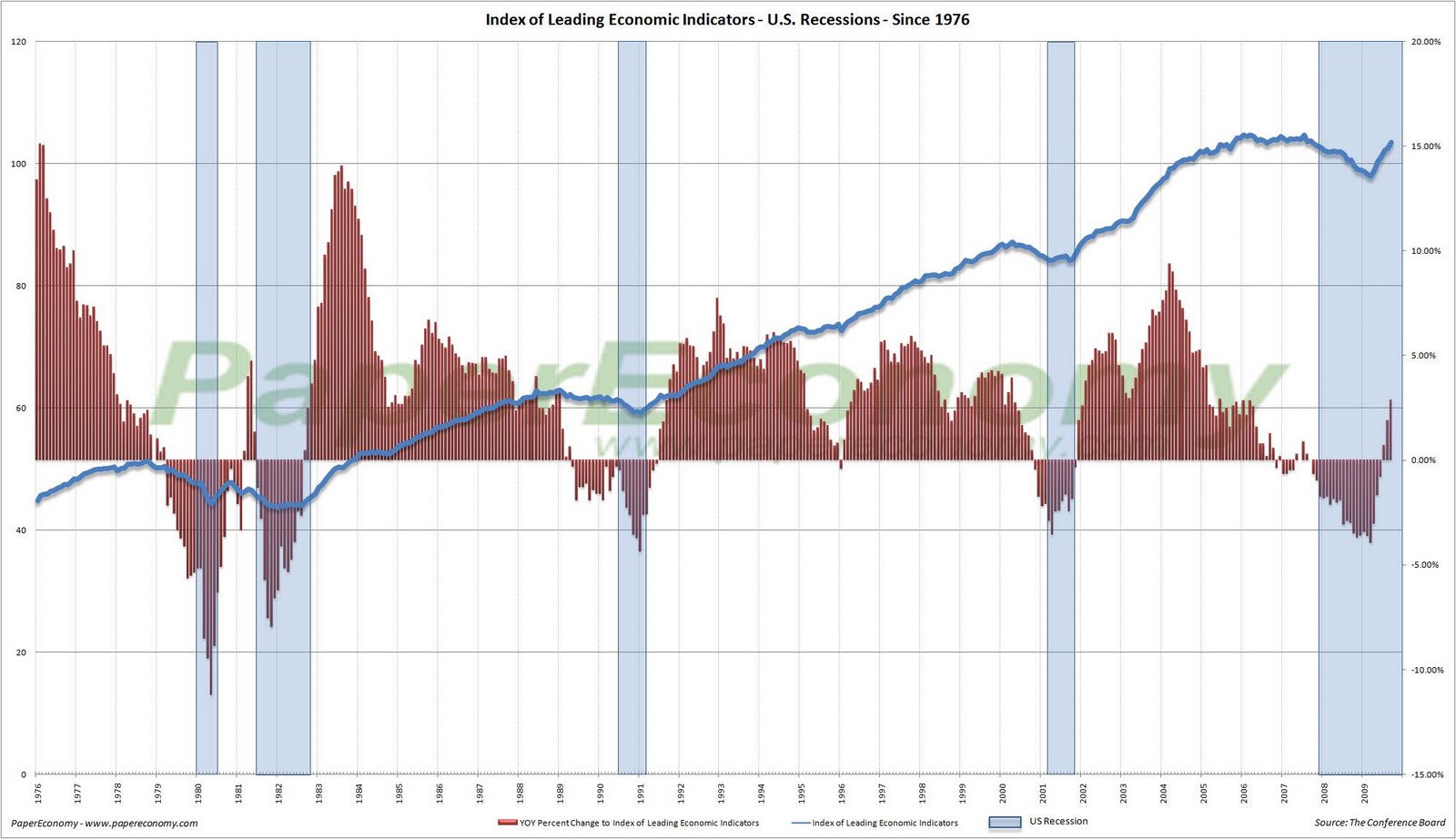
The good news is the major leading economic indicators are showing some nice improvements. Most economists believe this is a sign we are headed out of recession and into recovery. Below is a link to a graph of an index of major indicators from the conference board showing this trend. What I find most interesting is the periodicity of recessions and recovery. Seems like a normal business cycle to me.
http://static.seekingalpha.com/uploads/2009/10/22/saupload_ilei0909index.jpg.
So, what does this graph have to do with a generational walk and data growth? Well, over the next 10 years there is expected to be a major shift in the generational make up of consumer spending in the US. The boomer generation’s contribution to potential consumer demand is expected to decline, while generation Y’s contribution to potential consumer demand is expected to increase. Moreover, Gen Ys tend to be very value conscious and price sensitive. The next link shows the generational walk I’m referring to.
http://seekingalpha.com/article/168342-the-future-of-u-s-consumer-spending-it-s-a-generational-thing?source=email.
Let me continue my train of thought. There have been several reports out recently pointing to continued, rapid adoption and growth of wireless data services. One of the predictions has the compounded annual growth rate for mobile data at 131 percent over the next 5 years. A big percentage of this is no doubt Gen Y. Okay, I know what you are thinking; get to the point, right? Well, if our point of departure is the beginning of the fragile recovery noted in the graph mentioned above and linked to the first URL, and the Gen Y group is taking over as the major demand driver for consumer spending as noted before and depicted in the graph linked to the second URL, and they are one of the big contributors of the mobile data growth just mentioned, and they are value conscious and price sensitive, wireless carriers better figure out fast how to lower their costs to deliver all that Gen Y generated mobile data traffic. If they don't, the telecommunication industry’s contribution to a long term economic recovery will be in question. Do I hear the stampede to 3G and 4G networks?
Link to mobile data growth projections:
http://www.cisco.com/en/US/solutions/collateral/ns341/ns525/ns537/ns705/ns827/white_paper_c11-520862.html.
IT spending priorities
Several annual surveys came out in the last few weeks trying to forecast IT spending trends for 2010. All of them pretty much agree on the same general trends and focus areas of investment dollars. First, the sentiments for increases in IT spend in 2010 have improved. This is most likely due to general feelings about the economy and its stability. While most economic leading indicators continue to show improvement, lagging indicators continue to remain in a fragile state. Nevertheless, this is an improved state from last year or even earlier this year. As a result, IT professionals have a less pessimistic view of 2010 spending.
The spending priorities for IT in rank order of most important to least important are:
Storage
Networking
Servers
Software-infrastructure
PCs
Software Applications
IT services
Without a doubt, storage, networking, and servers are the primary focus areas for IT leaders. The main drivers of the focus in these areas are modernization and capacity for growth. The modernization is in the form of server and storage virtualization. For wireless, it is user generated data traffic growth driving the need for more storage and processing capacity for core back-office systems.
Within the network category, WAN optimization, IP telephony, Layer 2-3 Ethernet switching, and video conferencing are driving spend. Believe it or not, Windows 7 does not appear to be getting too much focus right now. WAN and IP telephony are most likely getting attention because they can potentially lower costs as traffic volume goes up.
Cloud computing
Everybody is talking about cloud computing and how it is going to revolutionize the way people and business do things. Cloud computing is most often discussed in the context of mega data centers run by the likes of Google, Microsoft, Cisco, and a few others, providing smaller, less capable companies and businesses all components of the stack (infrastructure, application, etc.) in a very scalable and cost effective manner. I read an interesting article in Business Week about the smartphone and cloud computing. The article is noted below for your reference. Anyway, when you think about it, the smartphone is really quite dependent today on the cloud concept.
http://images.businessweek.com/ss/09/06/0604_cloud_computing/3.htm.
http://images.businessweek.com/ss/09/06/0604_cloud_computing/3.htm.
Web 2.0 Tools
In my business, as fast as it is changing, I need to stay up on the news for the business sector (wireless telecommunications). I'm also very much on the go and spend little time at a desktop. I have been using a cool tool for my Blackberry called Viigo. Viigo lets me aggregate my news in a single location (my Blackberry) and get news and headlines via RSS feeds in almost real-time. With this application on my Blackberry, I'm able to quickly scan the information and then bookmark it with Delicious for later consumption and research. The application can be downloaded free of charge to your Blackberry from www.viigo.com. This site also allows you to add or delete RSS feeds, if you choose not to do it from your Blackberry. For those of you that like the iPhone, Newsstand pretty much does the same thing. You can download it from the Apple application store or http://www.omz-software.de/newsstand/.


Tuesday, October 20, 2009
Social media Web 2.0 concerns
Social media and social networking sites are taking off around the world. Facebook and Twitter are the top two social media/networking sites. Businesses are seeing both the potential and risk with these technologies. As an example of the potential, social networking sites can facilitate greater collaboration and sense of being across geographically dispersed work groups. At the same time, these networking sites can be abused. Employees can use them intentionally or unintentionally to post confidential or proprietary company information. One point of view is to block or prohibit employees from using these types of Web 2.0 tools. Another point of view is to recognize the potential and provide guidance and rules governing the use of the tools, explaining the risks to the company and the obligations of the employee.
Following is a cool tool I like called Delicious. It is a bookmarking tool that allows the user to bookmark useful information from a laptop, blackberry, iPhone, or other device for later searching or retrieval.

http://delicious.com/
Sources:
http://www.fastforwardblog.com/2009/10/15/mr-cio-tear-down-this-wall
Saturday, October 17, 2009
Android versus iPhone
There have been a few reports out this week on smartphone trends. The reports have touched on operating system dominance, user loyalty, and carrier acceptance. One analyst predicts that the Android platform will surpass the iPhone platform in 2012, with Symbian still being number one, and iPhone number three. This is based on the belief that multiple carrier adoption of the Android device will drive growth. I think this makes sense, if you assume Apple does nothing and the carriers that adopt the Android platform can develop a user interface on the Android OS that can compete with the iPhone user interface. The iPhone user interface and the sleekness of the device have created a level of loyalty that is unmatched. One recent report had the factors most important to smartphone users as: operation (30%), operating system (22%), features (21%), physical design (18%), and battery life (9%). For overall satisfaction across all dimensions of satisfaction, the iPhone out scores all others by a healthy margin. Another smartphone survey showed that 92% of iPhone users feel the device is their ideal smartphone. All other smartphones users (Blackberry, Android, etc.) responded between 1% and 3% on this question. That's pretty darn impressive, but not surprising. The device is revolutionary. It's more than an OS; it's an experience, at least that's what some say.
So, what does Apple need to do to defend its lead? Well, if you believe that multiple carrier adoption will drive growth, perhaps they should get rid of the exclusivity deals. Moreover, they might want to come out with a few different flavors of the device, perhaps one should have a real keyboard, in addition to the fantastic touch screen. This would appeal to more business users who like the BlackBerry.
Sources:
http://forums.pinstack.com/f52/iphone_android_and_pre_beat_blackberry_and_legacy_smartphones114378/#post1204807
http://www.mobiadnews.com/?p=4032
http://www.appleinsider.com/articles/09/10/08/multi_phone_android_platform_seen_to_overtake_iphone_by_2012.html
Subscribe to:
Posts (Atom)