Hello folks and Happy New Year! Its been a few since my last post. I have been very busy with family, work, and school. I have attached a link to an excellent report on Internet usage. It's big but well worth your reading time. I believe it portends some major trends developing. As an industry, we have hit 2010 with wheels spinning full speed. The competitive salvos have started with VZ firing the first shot. Behind their "gun powder" is the fundamental belief that quality matters. For them it's the network. While I think this is a critically important attribute, the overall customer experience is what's most important. That includes network, the experience at the retail and customer service touchpoints, as well as the health of a company's culture. More than just my belief, there's a ton of academic research to back it up, including case studies. As you read the report on Internet usage, think about how the emerging trends in the report link or are impacted by the components of quality. Enjoy!
http://www.morganstanley.com/institutional/techresearch/pdfs/2SETUP_12142009_RI.pdf
Mike
Friday, January 22, 2010

Thursday, December 10, 2009
US Consumers and there consumption of information
Following for your reading enjoyment is a report on research conducted by a major university on the information consumption characteristics of the US consumer. It's pretty interesting.
http://hmi.ucsd.edu/pdf/HMI_2009_ConsumerReport_Dec9_2009.pdf
http://hmi.ucsd.edu/pdf/HMI_2009_ConsumerReport_Dec9_2009.pdf
Saturday, December 5, 2009
An analysis of a www.techcast.org forecast on smartphones
Good afternoon. I spent the better part of the week visiting some of our operating markets. One thing that is validated everywhere I go, mobile data growth is exploding. As the devices get more powerful in terms of memory, CPU, and user interface, consumers are getting more and more comfortable going online via the cell phone. There is an interesting forecast on the wireless space, specifically the smart phone, on Dr. Halal's web site www.techcast.org. This is an interesting site that contains forecasts for a number of fields and a number of technologies. Some that are covered are wireless, the mobile Internet, transportation, and space travel.
The method used by Dr. Halal is based on data for the particular field being forecast. However, an expert panel is then used to "zero" in on an accurate forecast for the field. Questions are submitted to the expert panel based on the analysis of existing data, basically asking them to predict when the technology is most likely to go main stream.
Following is my review and thoughts on the techcast forecast for smart phones at http://www.techcast.org/BreakthroughAnalysis.aspx?ID=69.
The techcast analysis predicts the smart phone will the primary device for accessing the Internet by 2020. The smart phone could combine the computing power of PC’s the networking of the Internet, the mobility of the wireless, and the video images of television with the communications of the telephone. Access technologies are advancing very rapidly. Examples of this are the fast migration to 4G from 3G. Advances in WiFi technology and the fact that multiple access technologies are being combined into the wireless device or smart phone offer additional validation that providing a rich and user friendly connection to the Internet is a meta objective for the industry and society. Other technology points worth noting: processor chips for smart phones are now capably of 1 GHz. The processing speed for PCs is around 4 to 6 GHz. The gap is closing. GPS functionality used to require a separate device. Now this capability is contained within the smart phone as a standard feature. The touch screen, once thought to be the user interface for the PC is now main stream with the smart phone. Obviously the Apple iPhone pioneered this and helped drive wide spread adoption. Some of the roadblocks the tech cast forecast notes are: memory, processing speed, and health concerns. One critical potential obstacle I did not see in the forecast is batter power. I do believe this is a potential road block. Even with the advances in Lithium battery technology, the processing demands, storage demands, and the user always on usage behavior is pushing the limits of current battery technology. The focus areas to address this are fuel cell technology and advanced charging mechanisms. Moreover, batteries that are composed of flexible material that use more of the available smart phone real estate are being explored.
Saturday, November 28, 2009
Friday, November 27, 2009
Wireless Trends
Hi all! I have not been as prolific in posting to my blog the past few weeks. I have been very busy with work (year-end stuff), school (several classes and dissertation work), and moving the family to our new home (money pit). Anyway, I’d like to share some thoughts with you on the industry.
Major trends
Major carriers continue to “tweak” their prepaid offerings. As a result of this, Leap and other prepaid focused carriers lost flow share. ARPU on the whole for the industry shows decline, although exploding demand for smart phone like devices continues to drive wireless data growth muting somewhat the voice ARPU declines. The wireline guys continue to show access line losses primarily driven by wireless substitution. The bright spot for this group is backhaul (of which they are the primary providers) and is expected to grow as more and more carriers commit to firm LTE (4G) deployment timelines. This is becoming more and more recognized as a necessity to support the exploding demand for mobile wireless data. Two other bright spots, in terms of growth, are the tower industry and data center ecosystem, both whose growth is indirectly driven by exploding mobile wireless data. As wireless carriers add a capacity to their 3G networks and begin the deployment of their 4G networks, they need to add equipment (antennas, tower top amplifiers, etc.) to the towers. Moreover, wireless data growth drives the need for routing equipment at the core and distribution layer of networks. The core routing equipment, as well as gateway equipment, is located in data centers. Data center space, power, and cooling needs are accelerating in synch with mobile wireless data adoption.
4G deployments (production and trial) are moving forward at a nice pace. VZ maintains it will have a number of large markets up and operational network year. Clearwire has launched additional markets with more planned. A significant number of carriers in the North America and abroad are conducting 4G trials, with LTE garnering most of the attention. The main driver for deployment and adoption of 4G by carriers is the explosive adoption of mobile wireless and the data usage that comes along with that. To provide a cost effective experience, carriers need faster networks that make better use of their available spectrum. 4G, and in particular, LTE, does this through a number of powerful techniques. The first is a new and improved modulation technique known as 64QAM. The second is the access technique known as OFDM. The third is MIMO, which uses multiple antennas to transmit and receive the signals. Lastly, wider spectrum bands magnify the above technological efficiencies.
The major factor that will potentially throttle deployment of LTE and other 4G technologies is building a full suite of end user devices. The device ecosystem is critical and could be a constraining force. Nevertheless, it is believed that devices will roll out in this order: single mode devices, dual chip solutions, and multi-mode devices solutions.
Additional thoughts…
Consensus is building that ATT will be losing its multi-year iPhone exclusivity in 2010, most likely mid year. Moreover, consensus is building that a CDMA version (CDMA/WCDMA) will be available next year. Some of the reasons for this belief are that the F.C.C. is looking into whether exclusive deals impede competition in the market, Apple sales soar in those markets where exclusive deals do not exist, and lastly, Apple most certainly does not want to help Android gain any better a foot hold. By the way, the Droid by all accounts is doing well. However, by all accounts and many, many reviews, the Droid is not an iPhone killer. It probably poses more of a threat to BlackBerry® and Palm Pre than it does to the iPhone.
Friday, November 20, 2009
HOLOGRAPHIC TECHNOLOGY AND CELL PHONES

Infosys predicted holographic cell phones sometime in 2010. They believe all the necessary technology is available today to make it a reality. There are several possible applications of holographic technology for cell phones. The first is for increasing the memory capacity of the cell phone. Holographic technology enables the storage of information at much greater densities than memory technologies such as flash memory. Higher density memory is important because of the increased use of multimedia applications on cell phones.
The second possible application of holographic technology is for displaying the image of the person communicating with the device. Because of how holographic technology works, the size of the projected image can be much larger than the projecting device, which in this case is the cell phone. I really don’t think we will see commercially available simple, holographic mobile devices for another 5 years, at least. One reason is the computational requirements necessary for holographic technology and the burden this would put on the mobile device, which will need most of its CPU horsepower for processing the advanced radio access protocols that are being rolled out, exceeds the current processing capabilities of even the most powerful cell phone. Moreover, holographic projection does require lasers. Cell phones have already hit the wall in terms of battery capacity. This is another roadblock that will need to be resolved before holographic technology is ready for primetime. According to Gartner research, the technology is still very much in the laboratory. When viewed from the point of view of the Gartner hype cycle, volumetric display technology is 10 plus years away, with volumetric human-machine interaction even further out. Nevertheless, the technology has promise and will eventually happen.
Friday, November 13, 2009
New cool web 2.0 tool
You don't have to use text to share your thoughts on a particular subject in the web 2.0 world. In today's busy society, sometimes recording your thoughts is the easiest way to share your thoughts and maximize your productivity while driving, riding, or walking. Follwing is a podcast using a cool web 2.0 tool called gabcast. Check it out.
Gabcast! Musings of a CTO #1
Gabcast! Musings of a CTO #1
Web 2.0 application
In a previous post, I shared with you a news aggregator for your mobile called Viigo. Great tool for ingesting lots of news and information while your on the go. While at your laptop or desktop, an excellent "meta" aggregator is "popurls" at http://www.popurls.com/. This site pulls information together from some of the best sites out there (delicious, digg, etc.). I like it because it presents it all in a nice, digestable, panoramic view. You can also customize it.


Saturday, November 7, 2009
Structured Design Process
The current process for new drug development and commercialization is very long. The industry claims this process can take 12 to 15 years. This time line is shocking when you think of the opportunity lost and opportunity cost. The industry and the government have identified front-end work as the major opportunity phase in the drug development life cycle. The front-end process is defined as the tasks that include new product concept and definition, technology and technical approach selection, requirements definition, and market positioning. This phase of the process requires involvement of many people from different functional areas with very different perspectives. During the process, collaboration, open communication, and solid team dynamics are critical for success.
The drug industry realized that during this phase there is quite a bit of unstructured activity. The SDP approach was applied to improve the front-end component of the drug life cycle process. The benefits of using the SDP are reducing the work that normally takes weeks to just several days. Moreover, the SDP enables better quality products and faster termination of bad products, reducing the size of wasted assets.
The SDP in this case maintained a triggering question which in essence kept the various teams focused on maximizing profits and reducing time to market. Some of the specific benefits that resulted from the application of the SDP were:
130 well defined requirements
Affinity patterns were identified between requirements
114 options identified to help realize the options.
I think a really good application for the SDP is in the development of new products and systems in the wireless industry. One example that comes to mind for me is business process design for new business support systems. These systems are very complex and can include CRM, call and data rating, billing, invoicing, and a bunch of other stuff. When carriers migrate or attempt to migrate from their legacy BSS systems to the new BSS, major process redesign is likely. Getting alignment on which processes to retire, converge, or modified is critical and must be completed before implementation. Completing this phase can in many cases delay the project and seriously impact the schedule. The SDP process can potentially reduce the time to get through the business process design faster, with better alignment, and higher quality work.
Saturday, October 31, 2009
Predictions for wireless technology from www.trendsspotter.com
I found an interesting slide presentation from http://www.slideshare.net/TrendsSpotting/influencers-on-mobile-2009-2020-predictions-by-trendsspotting-presentation on the wireless industry. There are some very interesting predictions; some surprisng and some not so surprising.
Over the next 10 to 15 years, the individual’s primary mode of connecting to the Internet will be wireless. The wireless interconnection will be via WiFi, wireless WAN (4G and super 4G), and possibly one or more technologies similar to Bluetooth. Smartphones will improve in their processing capabilities and UIs and will continue to displace the laptop. Wireless usage begins to approach that currently generated on cable and DSL. China starts to set the standard for high density wireless architectures.
We are seeing some of these trends develop today. For instance, smartphones now constitute between 20 and 30 percent of all new phone sales. The processor speed of the modern smartphone is already at 400 to 600Mhz and is expected to increase. The iPhone user now consumes 200Mbs/month. I do believe China will play a major role, but so will India.
Source: http://www.slideshare.net/TrendsSpotting/influencers-on-mobile-2009-2020-predictions-by-trendsspotting-presentation.
Saturday, October 24, 2009
The economy, a generational walk, and data growth
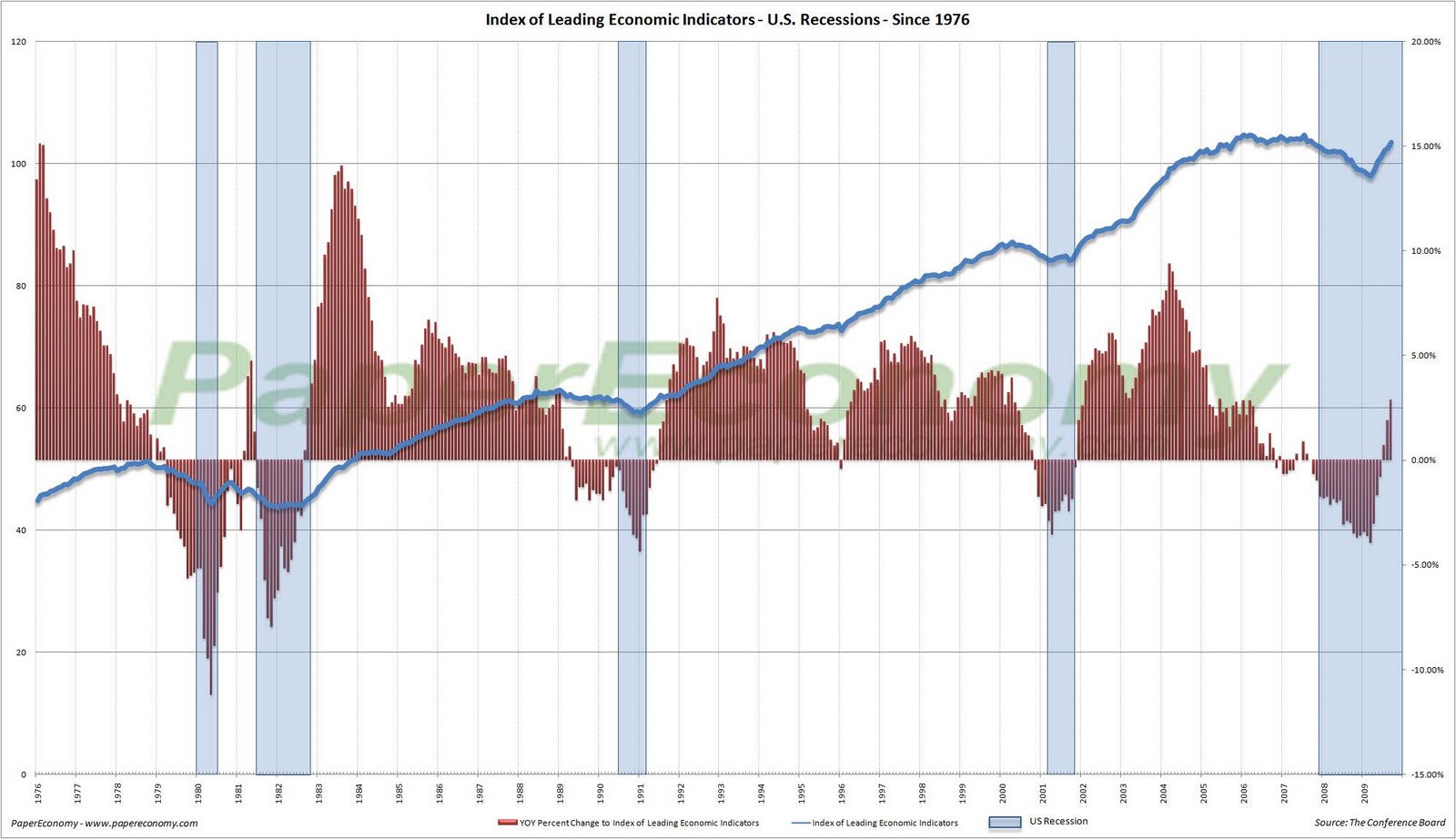
The good news is the major leading economic indicators are showing some nice improvements. Most economists believe this is a sign we are headed out of recession and into recovery. Below is a link to a graph of an index of major indicators from the conference board showing this trend. What I find most interesting is the periodicity of recessions and recovery. Seems like a normal business cycle to me.
http://static.seekingalpha.com/uploads/2009/10/22/saupload_ilei0909index.jpg.
So, what does this graph have to do with a generational walk and data growth? Well, over the next 10 years there is expected to be a major shift in the generational make up of consumer spending in the US. The boomer generation’s contribution to potential consumer demand is expected to decline, while generation Y’s contribution to potential consumer demand is expected to increase. Moreover, Gen Ys tend to be very value conscious and price sensitive. The next link shows the generational walk I’m referring to.
http://seekingalpha.com/article/168342-the-future-of-u-s-consumer-spending-it-s-a-generational-thing?source=email.
Let me continue my train of thought. There have been several reports out recently pointing to continued, rapid adoption and growth of wireless data services. One of the predictions has the compounded annual growth rate for mobile data at 131 percent over the next 5 years. A big percentage of this is no doubt Gen Y. Okay, I know what you are thinking; get to the point, right? Well, if our point of departure is the beginning of the fragile recovery noted in the graph mentioned above and linked to the first URL, and the Gen Y group is taking over as the major demand driver for consumer spending as noted before and depicted in the graph linked to the second URL, and they are one of the big contributors of the mobile data growth just mentioned, and they are value conscious and price sensitive, wireless carriers better figure out fast how to lower their costs to deliver all that Gen Y generated mobile data traffic. If they don't, the telecommunication industry’s contribution to a long term economic recovery will be in question. Do I hear the stampede to 3G and 4G networks?
Link to mobile data growth projections:
http://www.cisco.com/en/US/solutions/collateral/ns341/ns525/ns537/ns705/ns827/white_paper_c11-520862.html.
IT spending priorities
Several annual surveys came out in the last few weeks trying to forecast IT spending trends for 2010. All of them pretty much agree on the same general trends and focus areas of investment dollars. First, the sentiments for increases in IT spend in 2010 have improved. This is most likely due to general feelings about the economy and its stability. While most economic leading indicators continue to show improvement, lagging indicators continue to remain in a fragile state. Nevertheless, this is an improved state from last year or even earlier this year. As a result, IT professionals have a less pessimistic view of 2010 spending.
The spending priorities for IT in rank order of most important to least important are:
Storage
Networking
Servers
Software-infrastructure
PCs
Software Applications
IT services
Without a doubt, storage, networking, and servers are the primary focus areas for IT leaders. The main drivers of the focus in these areas are modernization and capacity for growth. The modernization is in the form of server and storage virtualization. For wireless, it is user generated data traffic growth driving the need for more storage and processing capacity for core back-office systems.
Within the network category, WAN optimization, IP telephony, Layer 2-3 Ethernet switching, and video conferencing are driving spend. Believe it or not, Windows 7 does not appear to be getting too much focus right now. WAN and IP telephony are most likely getting attention because they can potentially lower costs as traffic volume goes up.
Cloud computing
Everybody is talking about cloud computing and how it is going to revolutionize the way people and business do things. Cloud computing is most often discussed in the context of mega data centers run by the likes of Google, Microsoft, Cisco, and a few others, providing smaller, less capable companies and businesses all components of the stack (infrastructure, application, etc.) in a very scalable and cost effective manner. I read an interesting article in Business Week about the smartphone and cloud computing. The article is noted below for your reference. Anyway, when you think about it, the smartphone is really quite dependent today on the cloud concept.
http://images.businessweek.com/ss/09/06/0604_cloud_computing/3.htm.
http://images.businessweek.com/ss/09/06/0604_cloud_computing/3.htm.
Web 2.0 Tools
In my business, as fast as it is changing, I need to stay up on the news for the business sector (wireless telecommunications). I'm also very much on the go and spend little time at a desktop. I have been using a cool tool for my Blackberry called Viigo. Viigo lets me aggregate my news in a single location (my Blackberry) and get news and headlines via RSS feeds in almost real-time. With this application on my Blackberry, I'm able to quickly scan the information and then bookmark it with Delicious for later consumption and research. The application can be downloaded free of charge to your Blackberry from www.viigo.com. This site also allows you to add or delete RSS feeds, if you choose not to do it from your Blackberry. For those of you that like the iPhone, Newsstand pretty much does the same thing. You can download it from the Apple application store or http://www.omz-software.de/newsstand/.


Tuesday, October 20, 2009
Social media Web 2.0 concerns
Social media and social networking sites are taking off around the world. Facebook and Twitter are the top two social media/networking sites. Businesses are seeing both the potential and risk with these technologies. As an example of the potential, social networking sites can facilitate greater collaboration and sense of being across geographically dispersed work groups. At the same time, these networking sites can be abused. Employees can use them intentionally or unintentionally to post confidential or proprietary company information. One point of view is to block or prohibit employees from using these types of Web 2.0 tools. Another point of view is to recognize the potential and provide guidance and rules governing the use of the tools, explaining the risks to the company and the obligations of the employee.
Following is a cool tool I like called Delicious. It is a bookmarking tool that allows the user to bookmark useful information from a laptop, blackberry, iPhone, or other device for later searching or retrieval.

http://delicious.com/
Sources:
http://www.fastforwardblog.com/2009/10/15/mr-cio-tear-down-this-wall
Saturday, October 17, 2009
Android versus iPhone
There have been a few reports out this week on smartphone trends. The reports have touched on operating system dominance, user loyalty, and carrier acceptance. One analyst predicts that the Android platform will surpass the iPhone platform in 2012, with Symbian still being number one, and iPhone number three. This is based on the belief that multiple carrier adoption of the Android device will drive growth. I think this makes sense, if you assume Apple does nothing and the carriers that adopt the Android platform can develop a user interface on the Android OS that can compete with the iPhone user interface. The iPhone user interface and the sleekness of the device have created a level of loyalty that is unmatched. One recent report had the factors most important to smartphone users as: operation (30%), operating system (22%), features (21%), physical design (18%), and battery life (9%). For overall satisfaction across all dimensions of satisfaction, the iPhone out scores all others by a healthy margin. Another smartphone survey showed that 92% of iPhone users feel the device is their ideal smartphone. All other smartphones users (Blackberry, Android, etc.) responded between 1% and 3% on this question. That's pretty darn impressive, but not surprising. The device is revolutionary. It's more than an OS; it's an experience, at least that's what some say.
So, what does Apple need to do to defend its lead? Well, if you believe that multiple carrier adoption will drive growth, perhaps they should get rid of the exclusivity deals. Moreover, they might want to come out with a few different flavors of the device, perhaps one should have a real keyboard, in addition to the fantastic touch screen. This would appeal to more business users who like the BlackBerry.
Sources:
http://forums.pinstack.com/f52/iphone_android_and_pre_beat_blackberry_and_legacy_smartphones114378/#post1204807
http://www.mobiadnews.com/?p=4032
http://www.appleinsider.com/articles/09/10/08/multi_phone_android_platform_seen_to_overtake_iphone_by_2012.html
Friday, October 16, 2009
4G and LTE
Several of you have asked about LTE versus WiMAX. From a technical point of view, the radio protocols have more in common than not. For instance, they both use OFDM and support advanced antenna technologies and modulation techniques. The uplinks are different, but on the whole, the protocols are similar. So, the natural question that follows is why would a carrier choose one versus the other given the similarities? The ecosystem should play a significant factor in deciding which to deploy. At a high level, I define ecosystem as the number of infrastructure providers, device providers, and middleware providers that support the protocol. Obviously, the larger and more developed the ecosystem, the better the cost curves, ongoing support, and new product development, to name a few. Following is a link to an analyst's view on LTE versus WiMAX.
From: LTE Ahead in 4G Race - Analyst Blog by Zacks Equity Research
Source: Zacks Investment Research - Analyst Blog, 9/28/2009.
Via: HighBeam™ Research
Copyright 2009 Zacks Investment Research
Source: Zacks Investment Research - Analyst Blog, 9/28/2009.
Via:
HighBeam™ ResearchCopyright 2009 Zacks Investment Research
Telecommunication outlook
Following is a link to an industry analyst's outlook on the telecommunications industry.
Some of the key opportunitities: teleccomunications is a necessary utility and massive growth of smart-phones.
Some of the key challenges: increased competition and weak credit profiles.
Some of the key opportunitities: teleccomunications is a necessary utility and massive growth of smart-phones.
Some of the key challenges: increased competition and weak credit profiles.
From: Telecommunications Industry - Industry Outlook by Zacks Equity Research
Source: Zacks Investment Research - Industry Outlook, 10/15/2009.
Via: HighBeam™ Research
Copyright 2009 Zacks Investment Research
Source: Zacks Investment Research - Industry Outlook, 10/15/2009.
Via:
HighBeam™ ResearchCopyright 2009 Zacks Investment Research
Wednesday, October 14, 2009
Horizon report and key technologies.
The Horizon report listed several critical technologies that need to be followed in terms of their impact to society in the future:
Mobile
Cloud computing
Personal Web
Geo
Smart-objects
Semantic aware applications
I have focused on mobile.
Mobile phone technology continues to advance at a fairly rapid pace. The advancements are occurring with the radio interface/protocol, the device user interface, and the delivery of content. The radio interface protocol for mobile phone technology has gone from analog, to digital (CDMA and GSM), and now to OFDMA/SCFDMA. Each of the advancements has further improved the spectral efficiency of the radio protocol by exploiting different dimensions of radio transmission. The first generations exploited frequency, time, and code space separately. The latest technology (OFDMA) exploits all three dimensions, achieving the highest spectral efficiency and getting very close to the theoretical limits of radio transmission. This is necessary because mobile phone adoption is increasing steadily, as is the adoption and use of mobile phone applications and service, both of which drive traffic on mobile phone networks. This adoption and increasing use of mobile phone applications is being drive by the tremendous advancements in mobile device user interfaces (touchscreens, widgest, etc.), which make it far easier for users to transmit and receive rich digital content.
One of the major trends to keep a close eye on is the migration and adoption of open mobile device operating systems. This trend is being given a big push by Google with their Android platform. This trend presents challenges and opportunities. The opportunities are in a greater array of mobile phones, which could spawn greater device innovation. The challenge with the open devices is ensuring a consistent user experience.
http://www.nmc.org/pdf/2009-Horizon-Report.pdf
Tuesday, October 13, 2009
Web 2.0 technologies
Web 2.0 technologies are all about collaboration and communication through content sharing. Couple Web 2.0 technologies with devices like the iPhone, and you have one powerful system for connecting and sharing with folks in near real-time. Here is a video I put together from pictures taken with an iPhone during our recent vacation to Disney and Universal. I used Animoto.com to mash'em together. Animoto.com is a really neat Web 2.0 tool for content creation and enhancement.
Subscribe to:
Posts (Atom)